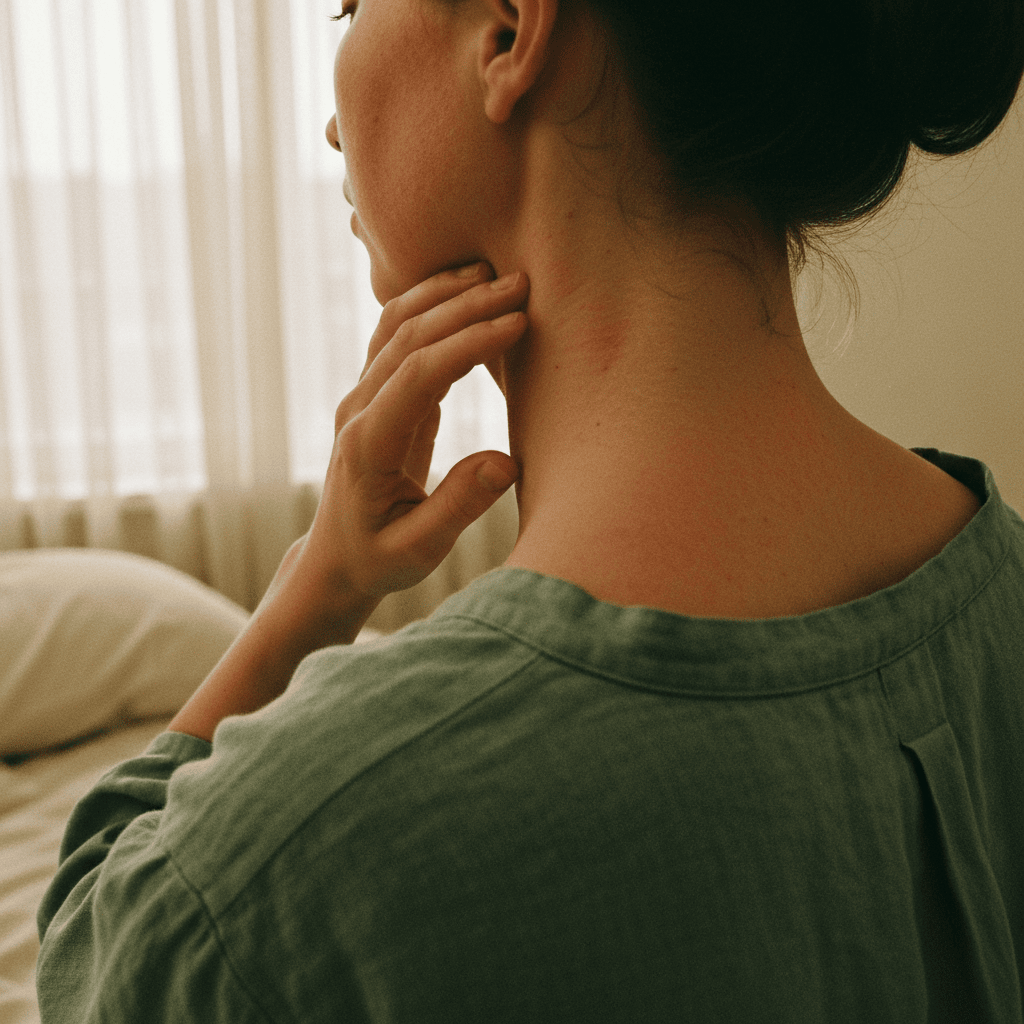
You're in an important meeting. Or maybe on a first date. Or just having a difficult conversation. And then you feel it: that familiar warmth creeping up your neck and chest.
You don't need a mirror to know what's happening. Red blotches are spreading across your skin like a neon sign announcing to the world: "This person is stressed."
It's embarrassing. It's visible. And the more you think about it, the worse it gets.
Your Skin Is Telling the Truth
Here's something most people don't realize: your skin is part of your nervous system. Literally. They develop from the same cells in utero. Your skin isn't just a covering. It's an organ that's in constant communication with your brain.
When your nervous system goes into alert mode, your skin responds. Blood vessels dilate. Histamine releases. And suddenly, you're wearing your stress on the outside.
The medical term is "stress-induced urticaria" or "emotional flushing." But you probably just call it "that thing that happens to my neck when I'm nervous."
And you've probably tried to hide it. Turtlenecks. Scarves in summer. Hair worn down. Strategic positioning so no one can see. You've become an expert at concealment because the alternative feels unbearable.
The Biology of Blushing
When your brain perceives threat (even social threat like being judged or put on the spot), it triggers a cascade of stress hormones. Adrenaline and cortisol flood your system. If you've ever woken up at 3am with your heart racing, you know exactly what this feels like.
One of the immediate effects? Blood rushes to the surface of your skin, particularly in areas with lots of blood vessels close to the surface. Your neck. Your chest. Your face.
This isn't a bug. It's a feature. In our evolutionary past, this response helped regulate body temperature during fight-or-flight situations. Your body was preparing to run or fight, and it needed to cool itself down.
The problem is that your body can't tell the difference between running from a predator and sitting in a performance review. The physiological response is the same.
The neck is particularly vulnerable because of its anatomy. Thin skin. Blood vessels close to the surface. Limited fat layer. It's basically a billboard for your internal state.
Why Stress Shows Up on Your Skin
Not everyone gets stress rashes. So why you?
There are a few factors. Genetics plays a role. Some people's blood vessels are closer to the surface or more reactive. Fair skin makes the flushing more visible (though it happens in all skin types).
But here's the bigger factor: how chronically stressed you are.
When your nervous system has been running on high alert for a long time, it becomes hypersensitive. Things that used to pass without a visible response suddenly set off the alarm. Your threshold has lowered. And this is where most people get it wrong: they think the problem is in the moment. But the real issue is in their nervous system, not their head.
The stress rash isn't just about the moment you're in. It's a sign that your baseline stress level is elevated. Your body is already primed for a reaction, and it doesn't take much to push it over the edge. The hidden costs of living with chronic stress add up in ways you might not expect.
Think of it like a cup that's already 90% full. It only takes a few drops to overflow. Someone with a 50% full cup can handle a lot more before anything spills.
Your neck rash isn't about what's happening right now. It's about everything that's been accumulating.
The Histamine Connection
There's another biological factor worth understanding: histamine. You probably associate histamine with allergies, but it plays a role in stress responses too.
When your body perceives threat, mast cells (part of your immune system) can release histamine. This causes the hives, the itching, the redness that characterizes stress rashes.
Some people are more prone to this histamine response than others. If you notice that your stress rashes come with actual raised bumps or itching, histamine is likely involved.
This also explains why the rash can seem to appear "for no reason." You might not feel consciously stressed, but if your body is chronically activated, histamine can release even without an obvious trigger.
The Cruel Feedback Loop
Here's where it gets really frustrating: the rash itself becomes a source of stress.
You feel the warmth starting. You know what's coming. You think, "Please not now, please not now." You get embarrassed about the rash, which increases your stress, which makes the rash worse.
It's a feedback loop that feels impossible to escape. The more you care about it, the more it happens. The more it happens, the more you dread it.
And telling yourself "just relax" is about as effective as telling yourself to think about anything except a pink elephant. The instruction itself guarantees failure. Your conscious mind has almost no power over this response.
The anticipatory anxiety can become almost worse than the rash itself. You might start avoiding situations where you know it could happen. You might turn down presentations, dates, or social situations because you can't face the possibility of visible stress.
This avoidance shrinks your life. And it doesn't actually solve the problem. It just moves it.
Situations That Commonly Trigger Stress Rashes
Understanding your triggers can help, not to avoid them forever, but to recognize the pattern. Common situations include:
Being the center of attention. Presentations, performances, toasts at weddings. Any situation where eyes are on you.
Conflict or confrontation. Difficult conversations. Having to advocate for yourself. Delivering bad news.
Being evaluated. Job interviews. Performance reviews. Meeting a partner's family for the first time.
Unexpected attention. Being called on in a meeting when you didn't expect it. Running into someone you weren't prepared to see.
Perceived judgment. Sensing that someone is critical of you. Worrying about what others think.
Physical triggers combined with stress. Heat, alcohol, spicy food, or caffeine on top of a stressful situation can make the reaction stronger.
Notice what they have in common: social threat. Your nervous system treats the possibility of negative social judgment the same way it treats physical danger. Because evolutionarily, social rejection was dangerous. Being cast out of the group could mean death.
Check In Right Now
Put one hand on your chest. Not on your heart, but on the area where the rashes usually appear.
Is there any warmth there right now? Any tension in your neck or shoulders that might be restricting blood flow? Notice without trying to change anything.
Now take a slow breath. Let your shoulders drop. Feel the temperature of your hand against your chest.
This simple act of noticing, without judgment, without trying to fix, is actually a form of nervous system settling. You're telling your body "I see you. You don't need to scream to get my attention."
If you're reading this because you just had an episode and you're upset, know that the rash will fade. It always does. The warmth will cool. The blotches will disappear. This moment is temporary, even though it doesn't feel that way.
What Doesn't Work
Willpower doesn't work. You can't think your way out of a physiological response.
Wearing turtlenecks doesn't help either. It might hide the rash, but it doesn't address what's causing it. And the internal sensation is just as uncomfortable. Plus, the extra fabric can actually make you warmer, which can worsen the flushing.
Avoiding situations that trigger it fails long-term. You end up shrinking your life to accommodate your stress response, which only increases anxiety-related nausea and other symptoms overall. Avoidance reinforces to your nervous system that these situations are actually dangerous.
Antihistamines might reduce the physical reaction temporarily, but they're treating the symptom, not the cause. And they don't help with the heat sensation or the underlying nervous system activation. Some people find they help take the edge off, which can break the feedback loop somewhat. But they're not a solution.
Alcohol might seem to help in the moment (it's a depressant, so it can temporarily reduce activation), but it also dilates blood vessels and can make flushing worse. And relying on substances to manage nervous system states creates its own problems.
What Actually Helps
The stress rash is a signal. It's your body saying: "My nervous system is stuck in high alert and needs help resetting."
The solution isn't to suppress the signal. It's to address what's causing it.
Lowering your baseline stress level. When your nervous system isn't already at 90% capacity, it takes more to trigger a visible response. This means addressing chronic stress, not just managing acute episodes.
Working directly with your nervous system. There are vagus nerve stimulation exercises you can do at home that help your body shift out of fight-or-flight mode. These approaches bypass the thinking mind entirely. They work through physical processes that help your body complete the stress cycle.
Practicing nervous system settling in low-stakes situations. The more your body experiences returning to calm, the better it gets at it. Start with situations that are mildly activating, not extremely triggering. Build the skill gradually.
Breathing patterns that activate the parasympathetic nervous system. Slow exhales, in particular, signal safety to your body. In a moment of rising stress, extending your exhale longer than your inhale can help interrupt the escalation.
Cold exposure on the back of your neck. This can stimulate the vagus nerve and help shift your nervous system state. Some people find that applying a cold cloth to the neck at the first sign of warming can reduce the intensity of the flush.
When your baseline stress level comes down, your threshold goes up. Things that used to trigger a visible reaction become more manageable. Your body stops screaming and starts speaking at a normal volume.
A Different Relationship With Your Skin
What if, instead of seeing the stress rash as an enemy, you saw it as information?
Your skin is giving you feedback that other people don't get. You have a built-in meter that shows when your nervous system is activated. That's actually valuable, even when it's inconvenient.
People whose stress is invisible can ignore it for years, accumulating damage without ever addressing it. You don't have that luxury. Your body forces you to pay attention.
What if the rash isn't a malfunction? What if it's your body insisting that something needs to change?
FAQ: Stress Rash on Neck
Why does my neck get blotchy when I'm stressed? Your neck has blood vessels close to the surface and thin skin, making blood flow changes more visible. When stress hormones trigger vasodilation (blood vessel expansion), your neck is one of the first places it shows.
Can stress really cause a rash? Yes. Stress triggers the release of hormones and histamine that cause blood vessels to dilate and can cause actual hives. This is a documented physiological response, not "just in your head."
How do I stop my neck from going red when I'm nervous? In the moment, there's not much you can do to prevent it once it starts. Extended exhales can help prevent escalation. Long-term, working on lowering your baseline stress level is what actually changes the pattern.
Will the rash go away on its own? The immediate rash usually fades within minutes to an hour after the trigger passes. The tendency to get stress rashes, however, typically requires addressing underlying nervous system dysregulation to truly change.
Is this the same as blushing? Related but not identical. Blushing usually affects the face and is associated with emotions like embarrassment. Stress rash tends to be blotchier, can affect neck and chest, and may include actual hives.
Should I see a doctor about stress rashes? If the rashes are frequent or severe, if you're not sure they're stress-related, or if they come with other symptoms, it's worth getting checked out to rule out other causes.
Your Skin Is Communicating
The stress rash isn't a character flaw. It's not weakness. It's not "being too sensitive."
It's your body giving you visible, undeniable feedback about the state of your nervous system. That feedback is valuable, even when it feels embarrassing.
Instead of fighting against it, what if you listened to what it's trying to tell you? Your skin is saying something. And understanding that message is the first step toward changing it.
Your neck doesn't have to be a source of anxiety forever. The pattern can change. It changes when your nervous system learns that it doesn't need to sound the alarm at every potential social threat.
Want to understand how stress might be showing up in your body? We've created a quick assessment that helps you identify your patterns, because knowing where you hold tension is the first step to releasing it.
Last updated: February 2, 2026