Everyone knows stress is bad for you. We hear it constantly—stress causes heart disease, weakens immunity, accelerates aging. But there's something most people don't understand about how stress actually works in your body.
Something that explains why you can go on vacation, get eight hours of sleep, do everything "right"—and still feel like you're running on empty.
Stress Isn't Just Mental
When we talk about stress, we usually talk about it like it's a mental phenomenon. Work stress. Financial stress. Relationship stress. The implication is that stress lives in your thoughts—and if you could just think differently, you'd feel better.
But stress isn't just thoughts. It's a full-body physiological event.
When your brain perceives threat—any threat, whether it's a tiger or a difficult email—it triggers a cascade of physical changes. Hormones flood your system. Muscles tense. Heart rate increases. Blood pressure rises. Digestion slows. Your entire body shifts into a survival state.
This is the stress response. And it's designed to be temporary—a quick burst of mobilization followed by a return to baseline.
The problem? In modern life, the return to baseline often never happens.
The Stress That Accumulates
Think about your typical day:
- Alarm jolts you awake (stress response)
- Check email, see something concerning (stress response)
- Traffic or commute delays (stress response)
- Difficult interaction at work (stress response)
- Financial worry crosses your mind (stress response)
- News headline catches your eye (stress response)
- Relationship tension at home (stress response)
Each of these triggers the same physiological cascade. But there's no moment to complete the cycle—no resolution, no return to true rest.
Instead, each stress stacks on top of the last. Your body never fully resets. The tension accumulates.
This is chronic stress—and it's not just a series of stressful thoughts. It's a physical state that your body gets stuck in.
How Accumulation Works Day by Day
Here's what most people miss: your body doesn't distinguish between "big" stress and "small" stress at a physiological level. That minor annoyance in the morning triggers the same hormonal response as a major crisis—just at a lower intensity.
But lower intensity doesn't mean lower impact when it happens dozens of times daily.
Think of it like a bank account, but in reverse. Every stressor makes a withdrawal. Every moment of true rest makes a deposit. Most people are making constant withdrawals with almost no deposits. The balance keeps dropping, but you can't see it. There's no statement, no warning before you're overdrawn.
By the time you notice—when you get sick, when you burn out, when anxiety becomes constant—you've been running a deficit for months or years.
What's Actually Happening in Your Body
When stress becomes chronic, several things happen at a physiological level:
Your Muscles Stay Contracted
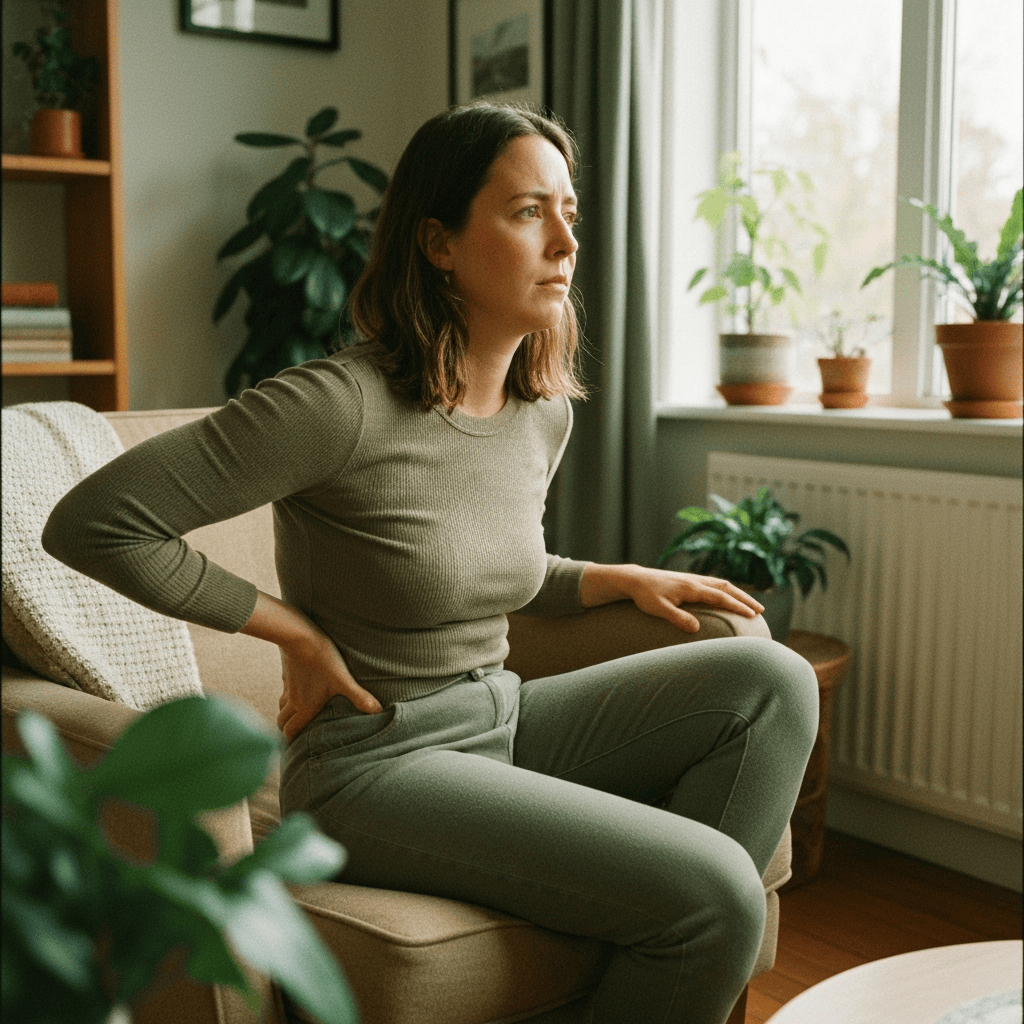
During a stress response, muscles tense in preparation for action, ready to fight or flee. When stress is constant, those muscles never fully release. This becomes the tight shoulders, clenched jaw, and stiff neck that you've probably accepted as "just how you are."
The muscle tension isn't random. It follows predictable patterns. Your shoulders creep up toward your ears. Your jaw tightens. Your hip flexors shorten from sitting in a braced position. Your lower back grips.
Over time, these patterns become structural. The fascia (the connective tissue wrapping your muscles) actually reshapes around the chronic tension. What started as a temporary brace becomes your body's default architecture.
Your Hormones Stay Elevated
Cortisol and adrenaline are meant for short-term emergencies. When they stay elevated, they start causing problems: sleep disruption, weight gain (especially around the midsection), impaired immune function, and difficulty concentrating.
Cortisol follows a natural rhythm—it should be highest in the morning (helping you wake up) and lowest at night (allowing sleep). Chronic stress flattens this curve. You wake up tired because your cortisol is low. You can't sleep because it spikes at the wrong times. The rhythm that's supposed to regulate your energy becomes chaotic.
This is why you can feel exhausted at 2pm but wired at 11pm. Your hormones aren't following their natural pattern anymore. They're responding to a stress load that never resolves.
Your Nervous System Stays on Alert
Your autonomic nervous system has two modes: sympathetic (activation) and parasympathetic (rest). Chronic stress keeps you tilted toward activation, even when you're technically "resting." This is why you can lie in bed exhausted but unable to actually relax.
This constant activation affects everything. Your heart rate stays slightly elevated even at rest. Your digestion is compromised because your body is directing resources toward "emergency" systems. Your immune response is suppressed because fighting infection isn't a priority when your body thinks it's in danger.
You might notice this as feeling "on edge" for no reason. Startling easily at sounds. Having trouble sitting still. Racing thoughts that won't quiet down. These aren't personality traits—they're symptoms of a nervous system stuck in threat mode.
Your Body Forgets What Baseline Feels Like
Perhaps most insidiously, your body adapts to this elevated state. The constant tension becomes normal. You don't even notice it anymore because you can't remember what true relaxation feels like.
This adaptation is actually a survival mechanism. Your nervous system assumes that if threat has been present this long, this must be the new normal. It recalibrates around the elevated state. What used to feel like "stressed" now feels like "normal." What used to feel like "normal" becomes inaccessible—you've literally forgotten the sensation.
This is why people who finally release chronic tension often describe the feeling as "coming home" or "remembering who I was." They're not just relaxing. They're rediscovering a baseline state their body had written off as impossible.
The Long-Term Cost
This isn't just about feeling tense or tired. The research on chronic stress is sobering:
Heart disease: Chronic stress is a major contributor to cardiovascular problems, independent of other risk factors. Some people even experience chest pain from emotional stress. The constant elevation in blood pressure and heart rate creates wear on arterial walls. Inflammation increases. Plaque builds up faster.
Immune suppression: People under chronic stress get sick more often and heal more slowly. Studies show that wound healing takes significantly longer when you're stressed. Vaccines are less effective. Your body simply doesn't have the resources to mount a proper immune response while it's busy preparing for danger.
Accelerated aging: Chronic stress literally shortens your telomeres, the caps on your chromosomes that are associated with aging. This isn't metaphorical aging—it's cellular. Your body is literally wearing out faster at a molecular level.
Cognitive decline: Prolonged cortisol exposure can damage the hippocampus, affecting memory and learning. Brain fog isn't just a feeling—chronic stress actually impairs the brain structures responsible for clear thinking.
Digestive problems: Your gut is sometimes called your "second brain" for good reason. Chronic stress disrupts the gut microbiome, increases inflammation, and can contribute to conditions from IBS to food sensitivities.
Mental health: Chronic stress is strongly linked to both anxiety and depression. But it's worth understanding the direction of causality—often the stress physiology comes first, and the anxiety or depression emerges as a response to a body that doesn't feel safe.
This isn't meant to stress you out more. It's meant to underscore that this is worth taking seriously—and that "managing" stress isn't enough if your body is still carrying the accumulated load.
Why "Relaxation" Often Doesn't Work
Here's what frustrates so many people: they try to relax. They take baths. They do yoga. They take vacations. And while these things feel nice in the moment, the underlying tension returns almost immediately.
That's because most relaxation activities work at the surface level. They can temporarily override the stress signals, but they don't address what's already accumulated in your body. The problem isn't your lack of willpower or discipline. It's that you're using mental tools for a physical problem.
It's like trying to drain a bathtub while the faucet is still running. You might make some progress, but the water level keeps rising.
The Relaxation Paradox
There's something else going on too. For many people, attempts at relaxation actually increase tension.
When you sit down to meditate and your mind races, you feel like you're failing. When you try to take a vacation and can't stop checking email, you feel guilty. The relaxation activities that are supposed to help become another source of stress.
This creates a paradox: the more you try to relax, the more tense you become. Because "trying" to relax is still effort. It's still your conscious mind attempting to override your nervous system.
Your nervous system doesn't respond to commands. It responds to signals. And the signal of "trying hard to relax" is still a signal of effort, of striving, of not being okay as you are right now.
The question isn't whether you're stressed—you probably are. The question is whether you're giving your body a way to actually release what it's holding, or just trying to cope with an ever-increasing load.
What Your Body Actually Needs
Your body knows how to release stress. It has built-in mechanisms for completing the stress cycle and returning to baseline. The problem is that modern life (and modern habits) often prevent these mechanisms from working.
Real stress release isn't about thinking calming thoughts or even doing traditionally relaxing activities. It's about giving your body the conditions it needs to do what it already knows how to do. This is why mind-body approaches often succeed where willpower alone falls short.
The Completion Problem
Here's what happens in nature: an animal faces a threat, has a stress response, escapes the danger, and then completes the cycle through physical discharge. A gazelle that escapes a lion doesn't just go back to grazing immediately. It literally shakes off the stress—its whole body trembles as the nervous system discharges the survival energy.
Humans have the same discharge mechanisms. But we suppress them. We hold still. We "keep it together." We sit in our chairs and absorb the stress response without ever allowing it to complete.
That incomplete stress cycle stays in your body. It becomes the tension you carry, the alertness you can't turn off, the exhaustion that sleep doesn't fix.
This is why some people find that certain practices create a shift that meditation, massage, and vacations never could—because they're finally addressing the physical accumulation, not just the mental experience.
Signs Stress Has Accumulated
How do you know if you're carrying accumulated stress? Ask yourself:
- Do you wake up tired, even after a full night's sleep?
- Is there tension in your body that never fully releases?
- Do you feel "wired but tired," exhausted but unable to truly rest?
- Does your mind race even when there's nothing to think about?
- Do you startle easily or feel on edge for no clear reason?
- Has it been so long since you felt truly relaxed that you're not sure what that would feel like?
- Do you clench your jaw or grind your teeth, especially at night?
- Is there stiffness in your neck or shoulders that massage only temporarily relieves?
- Do you feel like you're always bracing for something, even when things are fine?
- Have you noticed digestive issues that don't seem connected to what you eat?
If you said yes to several of these, your body may be holding more than you realize.
The Good News
The patterns aren't permanent. Your body is remarkably adaptable—the same adaptability that allowed stress to accumulate can work in reverse once you find the right approach.
People who've been carrying chronic tension for years often report profound shifts once they discover a method that actually works with their body's natural release mechanisms. The relief can be surprisingly fast when you finally address the right layer.
Your nervous system can recalibrate. Your muscles can remember how to let go. Your hormones can find their rhythm again. Your body wants to return to balance—it's been trying to this whole time. It just needs the right conditions.
Understanding Your Pattern
Everyone's stress pattern is different. Where you hold tension, how your nervous system responds, what your body needs—it varies from person to person. That's why one-size-fits-all advice often falls flat.
Some people hold stress in their jaw and shoulders. Others feel it in their gut or chest. Some become hyperactive and restless. Others shut down and feel frozen. Your pattern developed based on your history, your temperament, and what felt safest at the time.
The first step is understanding your own pattern.
Frequently Asked Questions
How long does it take for chronic stress to affect your health?
The timeline varies depending on the intensity of stress and your individual resilience. Some effects (like elevated blood pressure and disrupted sleep) can appear within weeks of sustained stress. Others (like immune suppression and cognitive changes) may develop over months. The structural changes to your body (like chronically tight muscles and altered hormone patterns) typically set in over years. The important point is that these changes are happening whether you notice them or not.
Can you reverse the effects of chronic stress?
Yes, most effects of chronic stress are reversible once you actually address the accumulated tension—not just manage ongoing stress. The body is remarkably resilient. People report improvements in sleep, energy, muscle tension, and mental clarity once they find approaches that work at the physical level. The timeline for reversal varies, but many people notice significant shifts within weeks of finding the right method.
Why do I feel stressed even when nothing stressful is happening?
This is a sign that your nervous system has become dysregulated—it's stuck in alert mode regardless of what's actually happening in your environment. Your body is responding to accumulated threat signals, not to present-moment reality. This is frustrating because it makes you feel like something's wrong with you, but it's actually a normal response to sustained stress exposure. It means the stress has moved from situational to physiological.
Is chronic stress the same as anxiety?
They're related but distinct. Chronic stress is a physiological state—elevated hormones, tense muscles, activated nervous system. Anxiety is often the psychological experience of that physiological state. You can have chronic stress in your body without consciously feeling anxious (this is common in people who've adapted to high stress). You can also have anxiety that's triggered by the physical sensations of chronic stress. Addressing the physical stress often reduces anxiety, which suggests the body state is often primary.
What's the difference between good stress and bad stress?
The stress response itself isn't good or bad—it's adaptive. "Good stress" (eustress) is temporary, motivating, and followed by recovery. "Bad stress" (distress) is chronic, overwhelming, or occurs without adequate recovery. The key difference isn't the stress itself but whether you complete the stress cycle afterward. A challenging workout is stress, but it's followed by rest and recovery. Chronic work pressure without recovery is stress that accumulates.
Want to understand how stress might be showing up in your body? We've created a quick assessment that helps you identify your patterns, because knowing where you hold tension is the first step to releasing it.
Last updated: February 2, 2026