Vagus Nerve Stimulation Exercises: A Step-by-Step Guide
Your body has a built-in calm-down switch. It's called the vagus nerve.
This nerve runs from your brainstem all the way down through your chest and into your gut. It's the main communication line between your brain and your body. And when you know how to activate it, you can shift out of anxiety and into calm—sometimes in minutes.
The problem? Nobody taught you how to use it.
You've probably heard about the vagus nerve. Maybe you've even tried a few things that claim to "stimulate" it. But if you're still struggling with anxiety, racing thoughts, or a body that won't relax, you haven't found the right approach yet.
That changes today. This guide gives you 10 specific exercises with clear, step-by-step instructions. No vague advice. No complicated equipment. Just practical techniques you can use right now.
What Is the Vagus Nerve and Why Does It Matter?
The vagus nerve is the longest nerve in your body. "Vagus" comes from the Latin word for "wandering"—and that's exactly what it does. It wanders from your brain through your face, throat, heart, lungs, and digestive system, connecting everything.
But here's what actually matters: the vagus nerve is your body's main brake pedal for stress.
Your Body's Built-In Calm System
You have two main modes: stress mode and rest mode.
Stress mode is your sympathetic nervous system—the fight-or-flight response. Your heart races. Your breathing speeds up. Your muscles tense. This is useful when you're actually in danger.
Rest mode is your parasympathetic nervous system—the rest-and-digest response. Your heart slows. Your breathing deepens. Your muscles relax. This is where healing happens.
The vagus nerve is the main pathway for rest mode. When it's active, it tells your body: "You're safe. You can relax now."
The problem is, most people's vagus nerve is weak from underuse. Their stress response fires easily. Their calm response barely works. They're stuck with the gas pedal floored and no brakes.
Natural vs. Medical Vagus Nerve Stimulation
There are two ways to stimulate your vagus nerve:
Medical stimulation uses an implanted device that sends electrical signals directly to the nerve. This is FDA-approved for epilepsy and treatment-resistant depression. It requires surgery and a doctor's supervision.
Natural stimulation uses exercises, breathing techniques, and physical practices that activate the nerve without any devices. This is what we're covering in this guide.
Natural methods work because the vagus nerve has branches throughout your body. When you stimulate those branches—through cold exposure, specific breathing patterns, or certain movements—you activate the whole system.
The best part? Natural vagus nerve stimulation is free, has no side effects, and you can do it anywhere.
10 Vagus Nerve Stimulation Exercises (Step-by-Step)
These exercises range from quick techniques you can use in moments of stress to practices you can build into a daily routine. Start with the ones that feel accessible, then experiment.
Exercise 1: The Physiological Sigh
This is the fastest natural way to calm your nervous system. Research from Stanford shows it can reduce stress in real-time—sometimes in just one or two breaths.
What it does: The double inhale fully inflates your lungs, including the tiny air sacs (alveoli) that tend to collapse when you're stressed. The long exhale activates your vagus nerve and signals safety.
How to do it:
- Take a deep breath in through your nose
- At the top of that breath, sneak in a second, shorter inhale through your nose (this "tops off" your lungs)
- Exhale slowly and completely through your mouth
- Let the exhale be long and relaxed—don't force it
- Repeat 1-3 times
When to use it: Anytime you feel stress rising. Before a difficult conversation. When you can't sleep. In traffic. During a panic attack.
Pro tip: You already do this naturally when you sob or when you sigh with relief. You're just doing it consciously now.
Exercise 2: Extended Exhale Breathing
Your inhale activates your stress response (slightly). Your exhale activates your calm response. By making your exhale longer than your inhale, you tilt the balance toward calm.
What it does: Lengthening the exhale directly stimulates the vagus nerve through the diaphragm and signals to your brain that you're not in danger.
How to do it:
- Sit or lie comfortably
- Breathe in through your nose for 4 counts
- Breathe out through your nose or pursed lips for 6-8 counts
- Don't strain—if 6 counts is hard, start with 5
- Continue for 5-10 minutes
When to use it: As a daily practice, ideally in the morning or before bed. Also helpful for winding down after work or preparing for sleep.
Pro tip: Put one hand on your belly. Make sure it rises when you inhale and falls when you exhale. This ensures you're breathing with your diaphragm, which maximizes vagal activation.
Exercise 3: Cold Exposure
Cold activates the vagus nerve powerfully. This is why splashing cold water on your face can stop a panic attack, and why cold showers leave you feeling calm and alert.
What it does: Cold triggers the "dive reflex"—an automatic response that slows your heart rate and activates the parasympathetic nervous system. It's a direct line to your vagus nerve.
How to do it (beginner):
- Splash cold water on your face, especially your forehead, temples, and under your eyes
- Hold a cold pack or bag of frozen vegetables against the side of your neck for 15-30 seconds
- Hold your wrists under cold running water for 30-60 seconds
How to do it (intermediate):
- At the end of your shower, turn the water to cold
- Start with 15 seconds of cold
- Focus on slow, controlled breathing
- Build up to 1-2 minutes over several weeks
How to do it (advanced):
- Take a full cold shower for 2-3 minutes
- Or immerse yourself in a cold bath (60-70°F) for 2-5 minutes
- Focus on keeping your breath slow and steady throughout
When to use it: Cold face/neck exposure works great during acute anxiety. Cold showers work well as a morning practice to build vagal tone over time.
Pro tip: The key is controlled breathing during cold exposure. If you're gasping and panicking, you're working against the technique. Start mild and build tolerance.
Exercise 4: Humming, Chanting, or Gargling
Your vagus nerve passes through your throat and connects to your vocal cords. Any activity that vibrates these structures stimulates the nerve directly.
What it does: The vibrations from humming, chanting, or gargling massage the vagus nerve where it passes through your throat. You might feel this as a slight tingling or warmth in your chest.
How to do it (humming):
- Take a deep breath in through your nose
- As you exhale, hum at a comfortable pitch
- Feel the vibration in your throat and chest
- Continue for 5-10 breaths
How to do it (chanting):
- Take a deep breath in
- Chant "OM" (or "AUM") as you exhale, drawing out each sound
- Feel the vibration move from your throat through your chest
- Continue for 5-10 repetitions
How to do it (gargling):
- Take a sip of water
- Tilt your head back and gargle vigorously for 30-60 seconds
- The goal is to engage the muscles in the back of your throat
- Do this 2-3 times per day (morning and night work well)
When to use it: Humming and chanting work well as part of a morning or evening routine. Gargling is easy to add to brushing your teeth.
Pro tip: Singing works too—especially singing loudly. Belt out your favorite song in the car. Your vagus nerve doesn't care if you're off-key.
Exercise 5: Ear Massage
A branch of the vagus nerve runs through your ear. Stimulating specific areas of your outer ear can activate the vagal system.
What it does: The auricular branch of the vagus nerve is accessible through your external ear. Massage here sends calming signals through the vagal pathway.
How to do it:
- Take your earlobe between your thumb and index finger
- Gently massage and pull downward
- Move up to the outer rim of your ear (the helix)
- Massage along the entire rim, using gentle pressure
- Spend extra time on the small flap at the ear canal entrance (the tragus)
- Continue for 2-3 minutes per ear
When to use it: Anytime you need quick calm—waiting rooms, before meetings, when you're feeling anxious.
Pro tip: You can do this discreetly. Just resting your hand on your ear and gently rubbing looks completely natural.
Exercise 6: Diaphragmatic Breathing (Belly Breathing)
Most anxious people breathe from their chest. This is stress breathing. Breathing from your diaphragm activates the vagus nerve because the nerve passes right through the diaphragm.
What it does: When your diaphragm moves fully, it massages the vagus nerve with every breath. This is why deep belly breaths feel calming.
How to do it:
- Lie on your back with your knees bent, or sit comfortably
- Place one hand on your chest and one on your belly
- Breathe in slowly through your nose
- Focus on making your belly hand rise while your chest hand stays still
- Exhale slowly, letting your belly fall
- Practice for 5-10 minutes
When to use it: Daily practice rewires your default breathing pattern. Also use it during stressful situations once you've built the habit.
Pro tip: If you can't get your belly to move without your chest, try this: imagine you're breathing into your lower back, or breathing into your pants pockets. This often helps engage the diaphragm.
Exercise 7: The Valsalva Maneuver (Modified)
This technique creates pressure changes in your chest that stimulate the vagus nerve. It's used medically to slow rapid heart rates.
What it does: The pressure change affects blood flow and triggers baroreceptors that activate the parasympathetic nervous system through the vagus nerve.
How to do it:
- Take a deep breath in
- Close your mouth and pinch your nose shut
- Try to exhale gently against the closed airway (like you're trying to pop your ears)
- Hold this gentle pressure for 10-15 seconds
- Release and breathe normally
- Repeat 2-3 times with breaks between
When to use it: When you feel your heart racing. When you need to quickly shift your state.
Caution: Don't bear down too hard—this isn't about straining. If you have heart conditions, high blood pressure, or glaucoma, skip this exercise or consult your doctor first.
Exercise 8: Eye Movements for Vagal Activation
Your eye muscles are connected to your brainstem near where the vagus nerve originates. Certain eye movements can trigger a relaxation response.
What it does: Slow eye movements activate the parasympathetic nervous system. Fast, darting eye movements are associated with stress (scanning for threats). By deliberately slowing your eye movements, you signal safety.
How to do it:
- Sit comfortably and relax your face
- Without moving your head, slowly look as far right as you can
- Hold for 30-60 seconds until you naturally sigh, yawn, or swallow
- Return to center
- Slowly look as far left as you can
- Hold for 30-60 seconds until you sigh, yawn, or swallow
- Return to center
When to use it: Before bed. During breaks at work. When you notice yourself feeling wired.
Pro tip: The sigh, yawn, or swallow is a sign that your parasympathetic system is activating. If it doesn't happen within 60 seconds, that's okay—your nervous system might need more time.
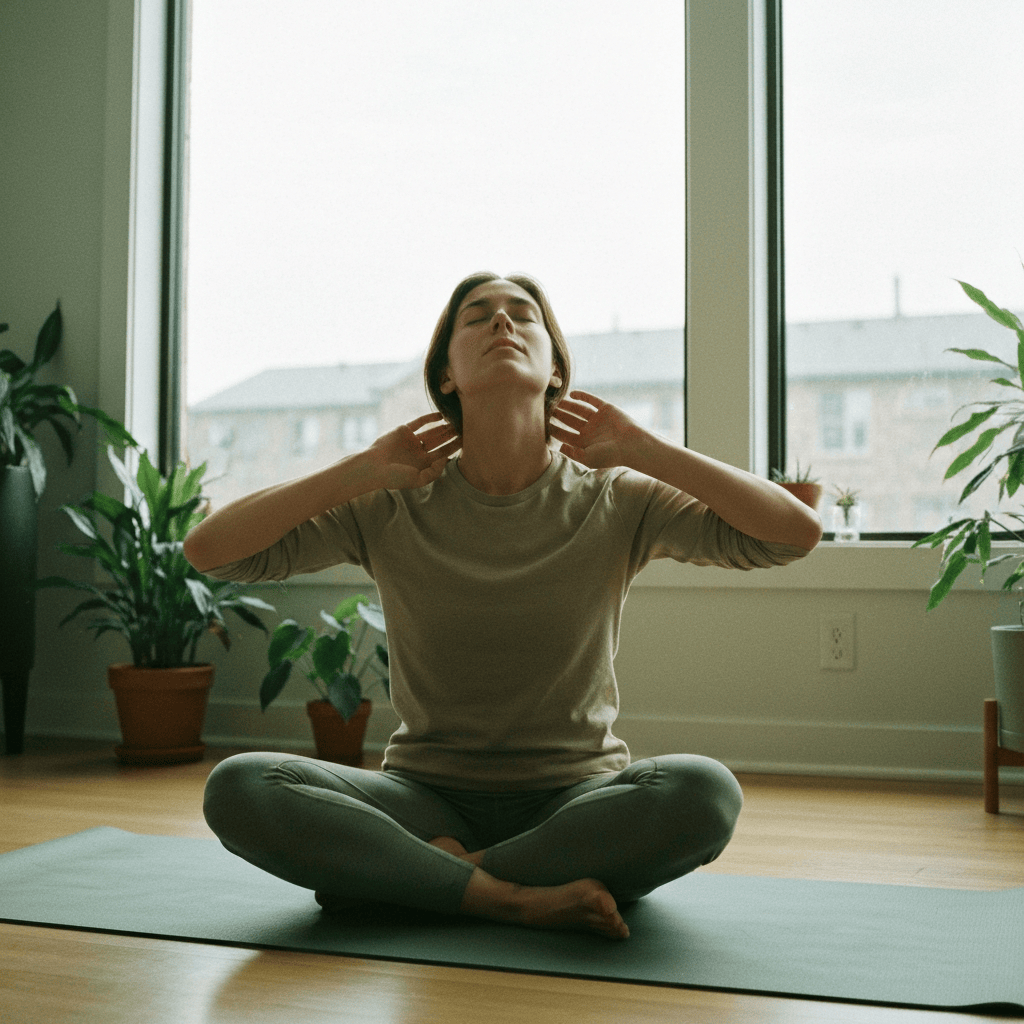
Exercise 9: Gentle Neck Stretches and Massage
The vagus nerve runs through your neck, closely associated with the sternocleidomastoid muscle (that big muscle on the side of your neck). Releasing tension here can improve vagal function.
What it does: Chronic neck tension can impede vagus nerve function. Releasing this tension allows the nerve to work more effectively.
How to do it (stretches):
- Sit or stand comfortably with your shoulders relaxed
- Slowly tilt your right ear toward your right shoulder
- Hold for 30 seconds, breathing slowly
- Return to center
- Tilt your left ear toward your left shoulder
- Hold for 30 seconds
- Drop your chin to your chest gently
- Hold for 30 seconds
How to do it (massage):
- Find the large muscle on the side of your neck (sternocleidomastoid)
- Using your thumb and fingers, gently squeeze and massage along its length
- Work from behind your ear down to your collarbone
- Spend 1-2 minutes on each side
- Use gentle pressure—this shouldn't hurt
When to use it: Daily, especially if you work at a computer. Also helpful when you notice you're holding tension in your shoulders and neck.
Pro tip: Combine with humming for double vagal activation—massage your neck while you hum.
Exercise 10: The Dive Reflex Technique
This technique uses cold and breath-holding to trigger the mammalian dive reflex—a powerful parasympathetic response that immediately slows your heart rate.
What it does: When your face is submerged in cold water and you hold your breath, your body thinks you're diving. It automatically slows your heart and redirects blood to essential organs. This is one of the fastest ways to activate the vagus nerve.
How to do it:
- Fill a bowl with cold water and ice (the colder the better)
- Take a deep breath and hold it
- Submerge your face in the water for 15-30 seconds
- Come up and breathe normally
- Repeat 2-3 times if needed
Simplified version:
- Fill a ziplock bag with ice water
- Lie down and place the bag over your forehead and eyes
- Hold your breath for 15-30 seconds
- Repeat as needed
When to use it: During acute anxiety or panic. When your heart is racing and you need fast results.
Caution: If you have heart conditions, talk to your doctor before trying this. The heart rate changes can be significant.
How to Know If Vagus Nerve Stimulation Is Working
So you've tried some exercises. How do you know if they're actually doing anything?
Signs of Improved Vagal Tone
Immediate signs (during or right after exercises):
- Deep, spontaneous sigh
- Yawning
- Swallowing reflex
- Gurgling stomach (digestion activating)
- Warmth spreading through your body
- Muscles relaxing
- Heart rate slowing
- Feeling of calm settling in
Long-term signs (with consistent practice):
- Lower resting heart rate
- Better heart rate variability (if you track this)
- Improved digestion
- Better sleep
- Quicker recovery from stress
- Less reactive to small annoyances
- More time feeling calm in your day
How Long Does It Take to See Results?
Some techniques work immediately. The physiological sigh, cold exposure, and dive reflex can shift your state within seconds or minutes.
Building overall vagal tone takes longer. Think of it like building a muscle. You won't see dramatic changes after one workout, but consistent practice over weeks and months creates lasting change.
Most people notice improvements in their baseline stress levels after 2-4 weeks of daily practice. The nervous system is adaptable—it can learn new patterns. But it takes repetition.
Building a Daily Vagus Nerve Practice
You don't need to do all 10 exercises every day. That would be overwhelming and unsustainable.
Instead, build a simple routine you can actually stick with.
Morning (5 minutes):
- Extended exhale breathing while still in bed (2 minutes)
- Cold water on face while washing up (30 seconds)
- Humming while you shower (2 minutes)
Throughout the day:
- Physiological sigh when stress spikes (30 seconds)
- Ear massage during breaks (1 minute)
Evening (5 minutes):
- Neck stretches and massage (2 minutes)
- Eye movement exercise (2 minutes)
- Extended exhale breathing before sleep (2-3 minutes)
That's about 10-15 minutes total, spread across your day. Completely doable.
Start with one or two exercises. Add more once those become habit. Consistency matters more than duration.
When Exercises Aren't Enough
Vagus nerve exercises are powerful. But they have limits.
If you're dealing with chronic anxiety, trauma, or a nervous system that's been stuck in stress mode for years, exercises alone might not be enough to shift your baseline.
Here's why: your nervous system holds onto past stress. It stores tension in your muscles and tissues. It remembers threats even when they're long gone. And until that stored stress is released, your system will keep defaulting to high alert.
Vagus nerve exercises can calm you down in the moment. But if you wake up every morning with your system already activated, you're starting from a deficit. You need to address what's keeping your nervous system stuck, not just manage the symptoms.
This is where body-based approaches that help release stored tension become essential. When your body can actually let go of the old stress it's been holding, your nervous system recalibrates. Your baseline shifts. And the calm you create with vagus nerve exercises starts to last.
FAQ
What is the fastest way to stimulate the vagus nerve?
The physiological sigh is the fastest natural method. Take a deep breath in through your nose, then sneak in a second shorter breath at the top. Exhale slowly and completely through your mouth. You can feel calmer in 1-3 breaths. Cold exposure (cold water on your face or the dive reflex technique) also works within seconds by triggering an automatic parasympathetic response.
What are the symptoms of vagus nerve problems?
Signs of poor vagal function include chronic anxiety that won't quit, digestive issues (bloating, constipation, or IBS), difficulty relaxing even when nothing is wrong, racing heart or heart palpitations, trouble swallowing, and feeling stuck in fight-or-flight mode. You might also have low heart rate variability, poor recovery from illness, and inflammation issues. These symptoms often overlap with chronic stress and anxiety.
How do you reset your vagus nerve?
Consistent practice of vagal stimulation exercises resets your nervous system over time. Start with breathing techniques (extended exhales, physiological sighs), add cold exposure, and include practices like humming or singing. The key is daily practice—your nervous system needs repetition to learn new patterns. Most people notice their baseline stress levels improving after 2-4 weeks of consistent practice.
What exercises calm the vagus nerve?
The most effective exercises include extended exhale breathing (inhale 4 counts, exhale 6-8 counts), cold water exposure on your face or neck, humming or chanting, ear massage, diaphragmatic belly breathing, gentle neck stretches, and eye movement exercises. Any activity that vibrates your vocal cords (singing, gargling) or creates pressure changes in your chest can also activate the vagal system.
Can you overstimulate the vagus nerve?
It's very rare to overstimulate the vagus nerve through natural exercises. The most you might experience is mild lightheadedness, which passes quickly. If you have certain heart conditions, the Valsalva maneuver and intense cold exposure could cause issues—check with your doctor first. For most people, natural vagal stimulation is safe and self-regulating.
How long should I do vagus nerve exercises?
For immediate stress relief, a few breaths or 1-2 minutes is often enough. For building long-term vagal tone, aim for 10-15 minutes of total practice spread throughout your day. Consistency matters more than duration—5 minutes daily beats 30 minutes once a week. Most exercises can be done in 2-5 minute sessions.
Does vagus nerve stimulation help with anxiety?
Yes. The vagus nerve is your body's main pathway for activating the calm-down response (parasympathetic nervous system). Stimulating it counteracts the stress response that drives anxiety. Research shows that higher vagal tone is associated with better emotional regulation, lower anxiety, and faster stress recovery. Regular practice can help shift your nervous system out of chronic stress mode.
Can you stimulate the vagus nerve while lying down?
Absolutely. Many exercises work well lying down—diaphragmatic breathing, extended exhale breathing, eye movements, and ear massage. Lying on your back with your knees bent is actually ideal for learning belly breathing because it's easier to feel your diaphragm move. The dive reflex technique and cold exposure exercises also work when lying down.
Take the Next Step
Vagus nerve exercises are a powerful starting point. They can help you manage stress in the moment and build a calmer baseline over time.
But if your nervous system has been stuck in stress mode for months or years, exercises alone might not be enough to fully reset it. Sometimes your body needs help releasing the stored tension that's keeping you stuck.
Take our free 2-minute quiz to discover what's driving your stress response—and learn about natural approaches that work with your body's built-in release mechanisms to help your nervous system truly reset.
[Take the Free Quiz]
Last updated: February 2, 2026