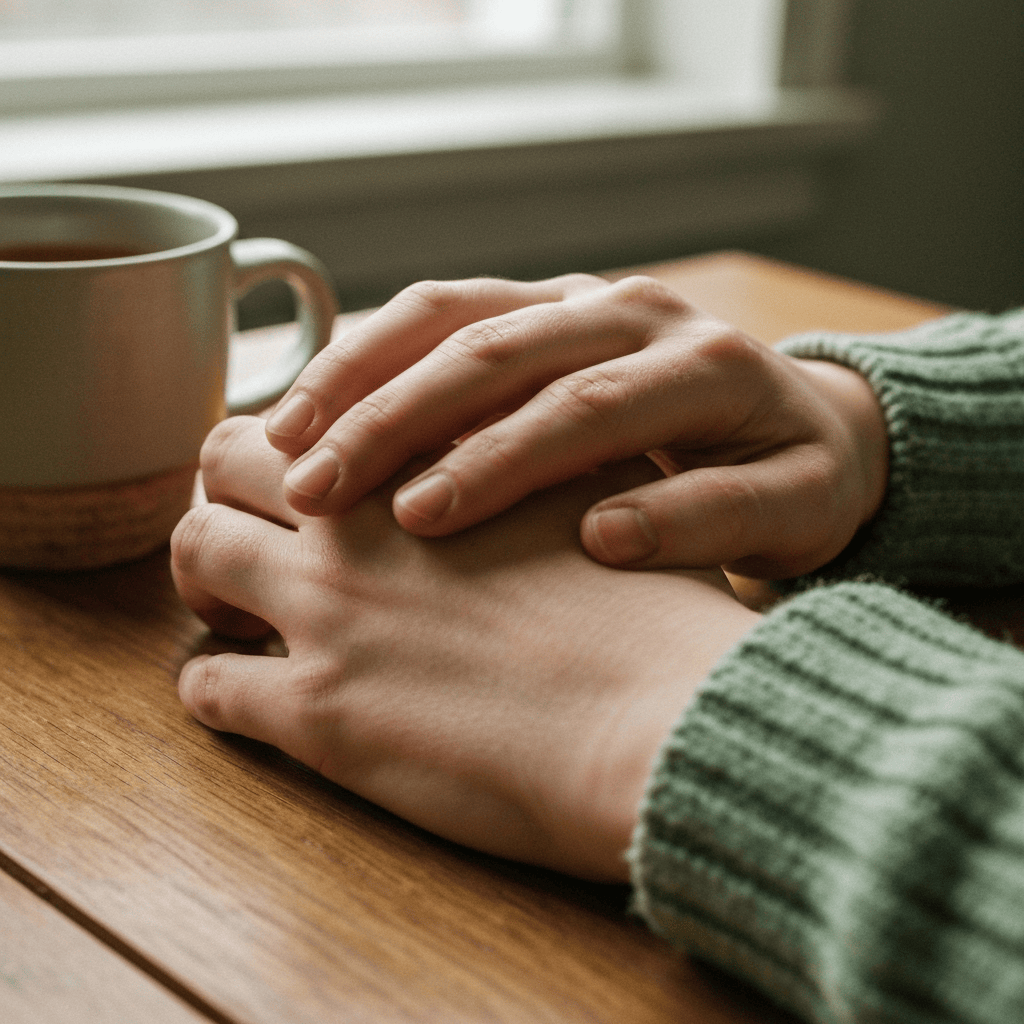
You're in a meeting. You reach for your coffee cup. And there it is. That familiar tremor in your hands that you can't control. You set the cup down quickly, hoping no one noticed. But you noticed. You always notice.
Or maybe it happens when you're signing a document. Holding your phone. Eating in front of others. Your hands shake, and the harder you try to steady them, the worse it gets. (And if you've also noticed nausea that comes with anxiety or a tight chest when this happens, you're not imagining that connection either.)
If this sounds familiar, you're not imagining it. And you're definitely not alone.
You're Not Losing Control
First, let's get this out of the way: shaking hands don't mean you're "losing it." They don't mean you're weak. They don't mean there's something fundamentally wrong with you.
What they mean is that your nervous system is doing exactly what it's designed to do under stress. It's just doing it at the wrong time.
Here's the thing: your body doesn't know the difference between a bear attack and a stressful email. When your brain perceives threat (any threat) it floods your system with adrenaline and cortisol. These hormones prepare you to fight or run.
Part of that preparation? Increased blood flow to your large muscles. Heightened muscle tension. A surge of energy that needs somewhere to go.
When you can't fight and you can't run, that energy has to discharge somehow. For many people, it comes out through their hands. For others, it shows up as air hunger that makes breathing feel incomplete or emotional chest pain that doctors can't explain. The location varies. The mechanism is the same.
The Science Behind the Shake
Your hands are incredibly sensitive. They have more nerve endings per square inch than almost any other part of your body. They're designed for precision. Which is exactly why they're so affected when your system is flooded with stress hormones.
When adrenaline hits, your muscles receive conflicting signals. Contract. Relax. Contract. Relax. This rapid-fire switching creates the tremor you see and feel.
It's called a physiological tremor. Everyone has one. It's just usually so small you can't see it. Stress, caffeine, fatigue, and anxiety all amplify it to the point where it becomes visible.
The cruel irony? Paying attention to it makes it worse. When you focus on your shaking hands, you add another layer of stress ("everyone's going to notice"), which releases more adrenaline, which increases the tremor.
You've probably noticed that the shaking gets worse precisely when you don't want it to. When you're trying to look calm and confident. When you're under observation. When it matters most. This isn't coincidence. It's the feedback loop in action.
Why Your Hands Won't Listen to You
You've probably tried to will your hands to stop shaking. Maybe you've gripped things tighter, thinking you could muscle through it. Maybe you've hidden your hands under the table or in your pockets.
None of it works. And here's why: you can't think your way out of a physiological response. It's not a mindset problem. It's a nervous system problem.
Your conscious mind can't override your automatic nervous system through willpower alone. That's like trying to lower your heart rate by concentrating really hard. Your body doesn't work that way.
The shaking isn't happening because you're not trying hard enough to stop it. It's happening because your nervous system is stuck in a state of high alert, and it's been that way so long it's become your baseline. This constant vigilance is often linked to hypervigilance symptoms that drain your energy.
The more you fight against the shaking, the more you're confirming to your nervous system that this is a threatening situation. "If I'm trying this hard to stop it, something must really be wrong." Your body reads your resistance as evidence of danger.
The Stuck Switch
Think of your nervous system like a thermostat. It's supposed to ramp up when there's danger, then settle back down when the danger passes. That's the healthy cycle.
But when you've been under chronic stress (whether from work, relationships, health issues, or just the general state of the world) that thermostat can get stuck in the "on" position.
Your body stays in a low-grade state of alert. Not full panic, but not truly relaxed either. And any additional stress (a difficult conversation, a tight deadline, being put on the spot) tips it over into visible symptoms.
The shaking hands aren't the problem. They're the symptom. They're your body's way of telling you that your nervous system needs a reset. Understanding the signs your body is holding stress can help you see the bigger picture.
This explains why the shaking might happen in situations that don't seem objectively threatening. You're not scared of the coffee cup. You're not in danger in the meeting. But your nervous system is already at 85% capacity, and that small added stress pushes it over the edge.
Common Triggers for Hand Tremors
Understanding when your hands shake can help you see the pattern. Common triggers include:
Being observed. Any situation where you feel watched. Eating in front of others. Writing while someone waits. Performing any fine motor task with an audience.
Performance pressure. When you need your hands to be steady for a specific task. Pouring a drink. Threading a needle. Signing your name.
Anticipatory anxiety. Before something stressful happens. The minutes before a presentation. The car ride to a difficult conversation.
Social anxiety situations. Meeting new people. Dates. Interviews. Any situation where you feel you're being evaluated.
Physical contributors. Low blood sugar. Caffeine. Lack of sleep. These amplify whatever nervous system activation is already present.
Accumulated stress. Sometimes the hands shake at random moments because the cumulative stress has reached a threshold. It's not about that moment specifically; it's about everything that came before.
Check In Right Now
Take a moment. Look at your hands. Are they completely relaxed? Or are they holding tension? Maybe gripping your phone, clenched slightly, or hovering over your keyboard with rigid fingers?
Now try this: shake them out. Like you're flicking water off your fingertips. Do it for 10 seconds.
Notice anything? That release of tension you feel? That's a tiny glimpse of what your body is trying to do when it trembles. It's trying to discharge stuck energy. It's trying to complete the stress cycle.
The difference is that intentional shaking gives you control. You're working with your body instead of against it.
Try another thing: let your hands hang completely loose at your sides. Let gravity pull them down. Let your fingers go soft. Breathe out slowly. Notice how different this feels from the constant low-grade tension you might normally carry.
What Doesn't Work
Telling yourself to relax. You know this by now. The instruction to relax when you can't is just another stress.
Gripping tighter. This increases tension, not steadiness. Your muscles are already overactivated; adding more activation doesn't help.
Hiding. Putting your hands in your pockets or under the table removes the immediate embarrassment but does nothing about the underlying state. And it confirms to your nervous system that the shaking is dangerous enough to hide from.
Caffeine avoidance alone. Yes, caffeine makes tremors worse. But if your nervous system is chronically activated, cutting caffeine won't solve the problem. It might reduce the intensity somewhat, but it won't address the root cause.
Distraction. Trying to think about something else. This rarely works because the physiological activation is still happening whether you're paying attention to it or not.
Alcohol. Some people notice their hands are steadier after a drink. This is because alcohol is a nervous system depressant. But using alcohol to manage anxiety-related tremors is a dangerous path that can lead to dependence.
What Actually Helps
Telling yourself to "just relax" doesn't work. You know that by now. What does work is giving your body what it's asking for: a way to release the built-up tension.
Working with the nervous system, not against it. There are body-based techniques that work directly with your nervous system, not around it. They don't require you to talk through your problems or meditate for an hour. They work with the physiology of stress to help your body complete the cycle it keeps getting stuck in.
Intentional physical discharge. The shaking you've been fighting against? It's actually closer to the solution than the problem. Your body already knows how to release stress. It's been trying to show you. Intentional shaking, bouncing, or other physical movement can help discharge the accumulated energy.
Breathing that signals safety. Extended exhales activate the parasympathetic nervous system. In moments of high activation, consciously lengthening your exhale can help your body shift out of fight-or-flight.
Reducing baseline activation. When your nervous system isn't already running at 85% capacity, occasional stress doesn't push it over the edge as easily. This means addressing chronic stress patterns, not just managing acute symptoms.
Accepting rather than fighting. This sounds counterintuitive, but when you stop fighting the tremor, you remove one source of stress. Sometimes the hands calm down when you stop demanding that they calm down.
Physical grounding. Pressing your feet firmly into the floor. Feeling the weight of your body in the chair. These sensory inputs can help orient your nervous system to the present moment, where there's actually no danger.
The question isn't how to stop the shaking. It's how to let your body finish what it's been trying to do all along.
Living With It While It Changes
Change doesn't happen overnight. While you're working on your nervous system, you'll still have moments when your hands shake. Here are some practical strategies:
Use both hands. If you're holding a cup or glass, use two hands. It's more stable and looks natural.
Choose heavier objects. A heavier cup is harder to shake visibly. Weightier pens are steadier.
Rest your elbows. When signing something or holding a document, let your elbows rest on the table.
Be open about it. Sometimes acknowledging "sorry, I'm a bit jittery today" takes the pressure off. When you stop trying to hide it, the feedback loop often decreases.
Plan for peak stress moments. If you know you'll be anxious (job interview, first date), plan around it. Don't schedule coffee-holding for those moments if you can help it.
These aren't solutions. They're accommodations while the real change happens underneath.
FAQ: Shaky Hands and Anxiety
Is it normal for hands to shake when you're anxious? Completely normal. It's a documented physiological response to stress hormones. Most people experience some degree of tremor when they're nervous or stressed.
Why do my hands shake when I'm not even feeling anxious? Your body might be in a state of chronic activation that you've become accustomed to. You might not feel consciously anxious, but your nervous system is still running on high alert. The shaking can also be triggered by physical factors like caffeine, low blood sugar, or fatigue.
Can anxiety cause permanent hand tremors? Anxiety-related tremors typically resolve when the nervous system settles. However, if your nervous system never fully settles, the tremors can become a chronic pattern. This doesn't mean they're permanent; it means the underlying nervous system state needs to be addressed.
Should I see a doctor about shaky hands? If the tremors are new, severe, occur at rest, or are accompanied by other symptoms, it's worth getting checked out. While anxiety is a common cause, tremors can also indicate other conditions that should be ruled out.
Why does trying to stop the shaking make it worse? Because the effort to stop it adds another layer of stress. Your nervous system interprets your resistance as confirmation that something is wrong, which releases more stress hormones, which increases the tremor.
Will this ever go away? For most people, yes. When the underlying nervous system dysregulation is addressed, the tremors become less frequent and less intense. The pattern can absolutely change.
What This Means For You
If your hands shake when you're anxious, you're not broken. You're not weak. You're not "too sensitive."
You're a human being with a nervous system that's working overtime. And that nervous system is giving you feedback. Visible, undeniable feedback that something needs to change.
Not your willpower. Not your attitude. But your relationship with stress itself. And that starts with understanding what's actually happening in your body.
Your hands don't have to shake forever. The pattern can change. It changes when your nervous system learns that it doesn't need to stay on high alert all the time. When it learns that it can discharge stress and return to baseline. When it learns that safety is possible.
Want to know how stress is showing up in your specific body? We've created a quick assessment that helps you identify your unique stress pattern, because everyone carries it differently.
Last updated: February 2, 2026