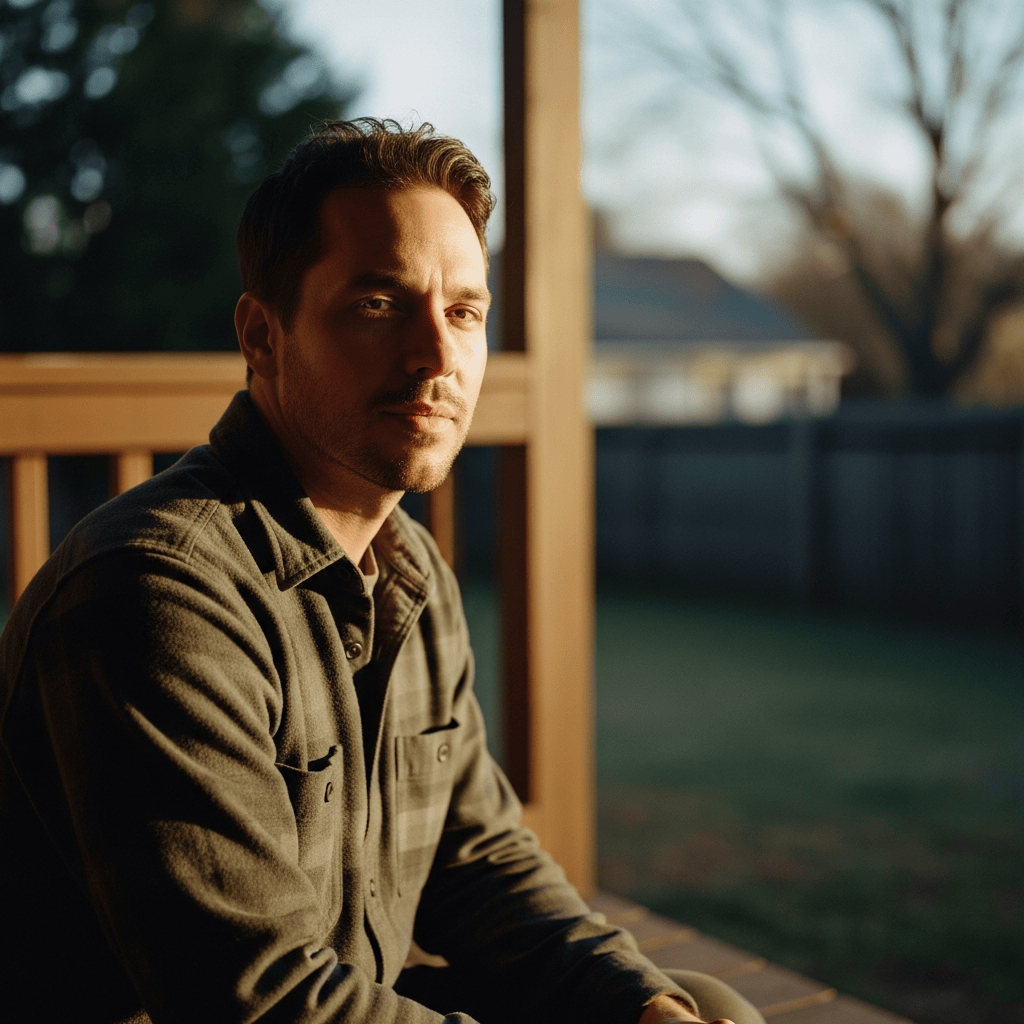
Something happened to you. Something that wasn't supposed to happen. A loss, a betrayal, an illness, a crisis that shook the foundations of your life. And now you're carrying it, whether you want to or not.
You're not who you were before. That person is gone. And in their place is someone you're still getting to know. Someone shaped by what you've survived.
People talk about trauma like it only destroys. And it does destroy things: innocence, assumptions, the life you thought you'd have. But sometimes, in the wreckage, something else emerges. Something that wasn't there before.
Psychologists call it post-traumatic growth. It's not a silver lining. It's not "everything happens for a reason." It's something more complicated, and more real.
What Post-Traumatic Growth Actually Is
Post-traumatic growth isn't about being grateful for your trauma. It's not about pretending everything turned out fine. And it's definitely not toxic positivity in disguise.
It's the recognition that struggle can catalyze change that wouldn't have happened otherwise. That wrestling with the worst can build strengths that comfort never required. That loss can clarify what actually matters.
Research has identified five common areas where people experience growth after trauma:
Personal strength: "If I survived that, I can survive anything." A new confidence in your ability to handle difficulty. This isn't arrogance—it's hard-won knowledge about your own resilience.
New possibilities: Paths that opened because old ones closed. Opportunities that came from being forced to change. Sometimes the detour leads somewhere you never would have found otherwise.
Relating to others: Deeper empathy. More authentic connections. Less patience for superficial relationships. When you've been through something real, small talk becomes harder—but real talk becomes easier.
Appreciation for life: Noticing what you used to ignore. Savoring what you used to take for granted. The ordinary becomes precious when you've experienced how quickly it can be taken.
Spiritual or existential change: New understanding of meaning, purpose, or what matters most. Frameworks that held your world together may have shattered, but what's rebuilt can be sturdier.
Not everyone experiences all of these. Not everyone experiences any of them. Growth isn't guaranteed, and its absence isn't a failure.
Growth and Pain Coexist
Here's the thing people get wrong about post-traumatic growth: they think it replaces pain. It doesn't. Growth and grief can exist in the same person, at the same time.
You can have developed new strength AND still carry deep wounds. You can appreciate life more AND still grieve what you lost. You can be glad for who you've become AND still wish you hadn't needed to become them this way. If you're dealing with lingering resentment about what happened, that's part of this too.
This isn't contradiction. It's the complexity of being human.
Anyone who tells you to focus only on the growth is minimizing your pain. Anyone who tells you growth is impossible is underestimating your capacity. The truth holds both.
The Both/And Reality
Western thinking tends toward either/or. Either you're healed or you're broken. Either you've moved on or you're stuck. Either you're grateful or you're bitter.
But that's not how humans actually work.
You can have mornings where you feel the growth—where you notice how much stronger you've become, how much clearer your priorities are, how much deeper your connections feel. And you can have afternoons where the grief hits fresh, where you'd give anything to go back to before, where the loss feels as raw as day one.
Both are true. Both are valid. Neither cancels the other.
The people who navigate trauma best aren't the ones who achieve some pure state of healing. They're the ones who learn to hold both—who stop demanding that they feel only one thing at a time.
The Struggle That Sparks Growth
Growth doesn't come from the trauma itself. If it did, more trauma would equal more growth, and that's not how it works.
Growth comes from the struggle to make sense of what happened. The wrestling. The reconstruction. The difficult work of rebuilding a worldview that was shattered.
When your assumptions about the world get destroyed ("bad things don't happen to good people," "I'm safe," "life is fair"), you're forced to build new ones. And sometimes the new assumptions are more resilient, more true, more life-giving than the old ones.
This isn't automatic. It requires processing. It often requires support. And it requires time. Growth usually becomes visible only in retrospect.
The Shattering of Assumptions
Before trauma, most people operate on a set of assumptions they don't even realize they're holding. That the world is basically fair. That effort leads to outcomes. That if you're a good person, bad things won't happen to you. That you're relatively safe.
These assumptions aren't exactly beliefs—they're more like the operating system running beneath your conscious awareness. They shape how you interpret everything without you noticing them.
Trauma crashes that operating system. Suddenly the assumptions are exposed as assumptions, not facts. The world clearly isn't fair. Bad things do happen to good people. Safety isn't guaranteed.
This is devastating. It's also an opportunity. Because assumptions you didn't choose—assumptions you inherited from your culture, your upbringing, your circumstances—can now be examined. Questioned. Replaced with something more honest.
The worldview that emerges from this reconstruction is often more nuanced than the one that was lost. It accounts for suffering without being defined by it. It acknowledges uncertainty without collapsing into nihilism. It's been tested by fire.
What Growth Requires
Post-traumatic growth tends to emerge when certain conditions are present:
Safety: You can't process trauma while you're still in it. Your nervous system needs to know the immediate threat has passed. This doesn't mean life has to be perfect—just stable enough that your body can shift out of survival mode.
Support: Connection with others who can witness your struggle without trying to fix it. People who can sit with you in the dark without reaching for the light switch. This is harder to find than it sounds, because most people are uncomfortable with pain.
Time: Growth doesn't happen on a timeline. It can't be rushed. The pressure to "get over it" or "move on" by some arbitrary deadline actually interferes with the processing that leads to growth. Your psyche will move at its own pace.
Meaning-making: The opportunity to construct a narrative that makes sense of what happened. Not a pretty story that ties everything up—a true story that acknowledges the complexity while still finding some thread of meaning.
Body processing: Trauma lives in the body. Growth often requires releasing what's held there. You can understand your trauma intellectually and still have a body that's stuck in it. Real integration requires the body to participate, not just the mind.
That last point matters more than people realize. This is why thinking your way through trauma only gets you so far. Your nervous system has its own memory, its own timeline.
The Body Remembers
Your body was there when the trauma happened. It absorbed the experience at a cellular level. The muscles that braced, the breath that caught, the posture that collapsed—these responses got recorded.
And your body hasn't necessarily gotten the message that it's over.
This is why someone can genuinely understand their trauma, can talk about it clearly, can even help others with similar experiences—and still have a body that's stuck. Still have nightmares. Still startle at triggers. Still carry tension that won't release.
The mind can update its understanding faster than the body can update its felt sense. Real healing requires both to catch up to each other.
This is also why growth sometimes stalls. You've done the mental work, the therapy, the journaling. But your body is still living in the trauma. The nervous system is still braced. Until that releases, full integration isn't possible.
Check In Right Now
Think about something difficult you've survived. Not the worst thing, necessarily, but something that changed you.
As you hold that experience in mind, notice: is there any part of who you are now that exists because of that struggle? Any strength, any wisdom, any compassion that developed in response?
You don't have to be grateful for the pain. You can acknowledge growth while still grieving the cost. Both are true.
Now notice your body. Is there still tension associated with that memory? Does your nervous system still activate when you think about it? Maybe your chest tightens, or your body holds pain that doesn't seem connected to anything physical. That tells you something about what might still need processing.
When Growth Feels Impossible
If you're reading this and growth seems impossibly far away, if you're still in the acute phase of trauma, still surviving, still just trying to get through the day, that's okay.
Growth isn't a requirement. Your job right now isn't to transform your suffering into something meaningful. Your job is to survive. To get through. To be gentle with yourself.
The growth, if it comes, will come later. When you have more distance. When your nervous system has had time to settle. When you can look back instead of just looking down at your feet, taking one step at a time. Some people find themselves waking at 3 AM with racing thoughts during this phase. That's your body still processing.
There's no timeline. Some people see growth emerging within months. For others, it takes years. Both are normal.
What "Not Ready" Looks Like
Sometimes growth isn't happening because you're not ready—and that's not a failure. It's information.
Signs you might still be in survival mode:
- Basic functioning takes all your energy
- You're just trying to get through each day
- Thinking about the future feels impossible
- Your nervous system is still highly activated
- You don't feel safe enough to let your guard down
- The trauma is still ongoing or too recent
If this is you, the task isn't growth. The task is stabilization. Finding safety. Getting support. Meeting your basic needs. Growth comes after survival, not during it.
Don't let anyone (including yourself) pressure you toward growth before you're ready. That's just another form of not being okay with where you actually are.
Supporting Your Own Growth
You can't force post-traumatic growth, but you can create conditions that support it:
Process with your body, not just your mind. Approaches that help your nervous system discharge held stress can free up energy for growth. Sometimes what feels like being "stuck" is your body still holding what your mind has already processed. Natural stress release through body-based methods can help complete cycles that stay incomplete.
Find witnesses, not fixers. People who can hear your story without rushing to make it better. Who don't offer platitudes or try to find the bright side. Who can simply be present with you in the difficulty. This is surprisingly rare and incredibly valuable.
Allow complexity. You can be grateful and grieving, stronger and wounded, changed and still healing. Let go of the need to feel only one thing. Your emotional landscape is allowed to be contradictory.
Be patient. Growth isn't linear. Bad days don't erase progress. Setbacks are part of the process, not evidence of failure. The path forward includes loops and reversals.
Tell your story, when you're ready. Narrative helps make meaning. But wait until you have enough distance. Telling too soon, before you've processed, can actually retraumatize. Let the story evolve as your understanding evolves.
Identify what's changed. Sometimes growth is happening without you noticing. Periodically ask: What's different now than before? What do I know now that I didn't? How have my priorities shifted? The changes may be subtle but significant.
The Person You're Becoming
The person you were before the trauma is gone. That's a loss worth grieving. But the person emerging in their place, forged by what you've survived, has capacities the old you didn't have.
Not better. Not worse. Different. Shaped by fire in ways that only fire can shape.
Growth doesn't make the trauma worth it. But it can make your survival mean something. Not because suffering is good, but because you're the kind of person who can transform it. That transformation isn't just mental. It happens in your body too. When your nervous system learns it's safe again, when stored tension finally releases, growth has room to take root.
The Integration
There's a point in healing where something shifts. The trauma isn't gone—it's still part of your story. But it's been integrated. It's no longer running the show from the shadows.
Integration doesn't mean the memories don't hurt. It means they hurt differently. Less sharp, more bittersweet. You can touch them without being flooded by them.
At this point, growth becomes more visible. You can see how the struggle shaped you. You can appreciate what it built without being grateful it happened. You can help others who are where you were, because you remember.
The person who emerges from integrated trauma isn't unburdened. They carry their history. But they carry it more lightly. It informs who they are without defining who they are.
Frequently Asked Questions
Can you experience post-traumatic growth and PTSD at the same time?
Yes, absolutely. Post-traumatic growth and post-traumatic stress disorder aren't opposites—they can coexist. You can have trauma symptoms (flashbacks, hypervigilance, avoidance) while also experiencing growth in certain areas of your life. In fact, some research suggests that the struggle with PTSD symptoms can itself be part of what catalyzes growth. The key is getting support for the distressing symptoms while remaining open to growth where it emerges.
Does everyone experience post-traumatic growth?
No. Post-traumatic growth isn't universal or guaranteed. Research suggests that around 50-70% of trauma survivors report at least some positive changes, but this varies widely based on the type of trauma, available support, individual resilience, and many other factors. The absence of growth isn't a personal failure—it may simply mean that circumstances haven't supported it, or that more time is needed.
How do I know if I'm experiencing post-traumatic growth or just trying to avoid my pain?
Genuine post-traumatic growth coexists with pain—it doesn't replace or avoid it. If you find yourself using "growth" language to dismiss or minimize your suffering, that's avoidance. If you can hold both the genuine difficulty and the genuine change, if you can acknowledge loss while also recognizing strength, that's more likely to be real growth. Another sign: genuine growth feels embodied and lived, not just thought or believed.
Is it possible to experience growth after childhood trauma?
Yes. Growth can emerge from any type of trauma, including early experiences. However, childhood trauma often requires more extensive processing because it happened during formative years and shaped core beliefs about self, others, and the world. The growth may look different—less "I survived that specific event" and more "I've developed capacities I didn't know I had" or "I understand myself and others more deeply."
What if someone keeps telling me I should see the silver lining?
Well-meaning people often try to rush others toward growth or gratitude because witnessing pain is uncomfortable. You're allowed to set boundaries. You can say: "I'm not there yet" or "I need you to just listen right now, not look for bright sides." Anyone who truly supports you will respect your timeline. And remember: feeling pressured to perform growth actually interferes with genuine growth.
How long does it take for post-traumatic growth to develop?
There's no standard timeline. Some people notice shifts within months of the trauma. Others don't see clear growth for years. Many factors influence the timeline: the nature and severity of the trauma, available support, safety and stability, personal history, and the kind of processing you're doing. Growth also often happens gradually rather than all at once—you may not notice it until you look back.
If you're working through something difficult and want to understand how stress is showing up in your body, we've created a quick assessment that can help. Because knowing where you're holding tension is part of knowing where growth might emerge.
Last updated: February 2, 2026